
From Chinoiserie to Kitenge
Updated: Jul 20
by Hangfeng Chen
In 2023, I traveled to Nairobi, Kenya, for the first time. Everywhere I looked, I encountered traces of China: railways, highways, high-rise buildings, industrial parks, smartphones, surveillance cameras, and countless everyday commodities. Yet what fascinated me most was something else entirely—the brightly patterned fabric that has come to symbolize "African identity": African Wax Print, known in Swahili-speaking East Africa as Kitenge.
With the help of a local assistant, I visited a number of fabric vendors. I noticed an intriguing contradiction. Almost every merchant knew that many of these textiles were manufactured in China, yet none of them presented them that way to customers. Instead, they described them as "authentic Dutch wax" or simply as "real African fabric." At one stall, I came across a cloth printed with a pattern that felt strangely familiar, and I bought it (see image below).

This Kitenge (photo by Hangfeng Chen) is showing in the exhibition Made in China at WereldMuseum Amsterdam, please see more details in the notes below.
That purchase led me to trace its history: what is now widely regarded as an emblem of African culture actually originated in Indonesia, where it is known as Batik. In the mid-nineteenth century, Dutch colonial manufacturers brought Batik back to Europe, hoping to reproduce it industrially and sell it back to the Dutch East Indies. The venture failed. Yet on their return voyages, Dutch ships stopped at ports along the West African coast, where these printed textiles found an enthusiastic market. Over time, they evolved into what we now know as African Wax Print.
More than a century later, these fabrics began another journey. Chinese factories started producing African Wax Prints on a massive scale, selling them across Africa at lower prices and with enormous commercial success. The Dutch company Vlisco has spent years attempting to prevent Chinese-produced textiles from entering the African market through legal means, but with limited success. In Patterns in Circulation, the American scholar Nina Sylvanus poses a compelling question: if Vlisco considers China's production to be an act of copying, how should it understand its own earlier reproduction of Indonesian Batik?
That question reminded me of another phenomenon I studied during my time at the Netherlands Film Academy: Chinoiserie. In 1655, the Dutch East India Company sent its first diplomatic mission to China. Although the delegation failed to establish formal trade relations with the Qing court, the accompanying artist Johan Nieuhof produced extensive drawings of the landscapes, architecture, and people he encountered. After returning to the Netherlands, his illustrations and travel accounts were published in Het Gezantschap, which quickly became one of Europe's most influential visual references for imagining China.

Paolinx Pagada from Het Gezantschap, Johan Nieuhof, ca. 1665
Looking at the book today, I find its images simultaneously unfamiliar and strangely recognizable, sometimes even surreal. Yet it was precisely these partial observations, misunderstandings, and imaginative reconstructions that shaped the rise of Chinoiserie. Delftware, tulip pyramids, and countless examples of Chinese-inspired painting, furniture, architecture, gardens, and fashion were never faithful representations of China. Rather, they reflected Europe's fascination with a distant culture it barely understood. Through processes of misreading, appropriation, and reinvention, a new hybrid aesthetic gradually emerged—one that would profoundly influence European visual culture and eventually contribute to the development of Rococo.

Plate with chinoiserie landscape with gilded details, anonymous, ca. 1680
Returning once again to African Wax Print, I began to see that it follows a remarkably similar logic. Today, fabrics produced in Chinese factories feature dragons, phoenixes, auspicious clouds, longevity symbols, and other traditional Chinese motifs woven together with the bold colours and graphic compositions associated with African Wax Print. These visual elements have embarked on yet another journey, entering everyday life across Africa in entirely new cultural contexts.
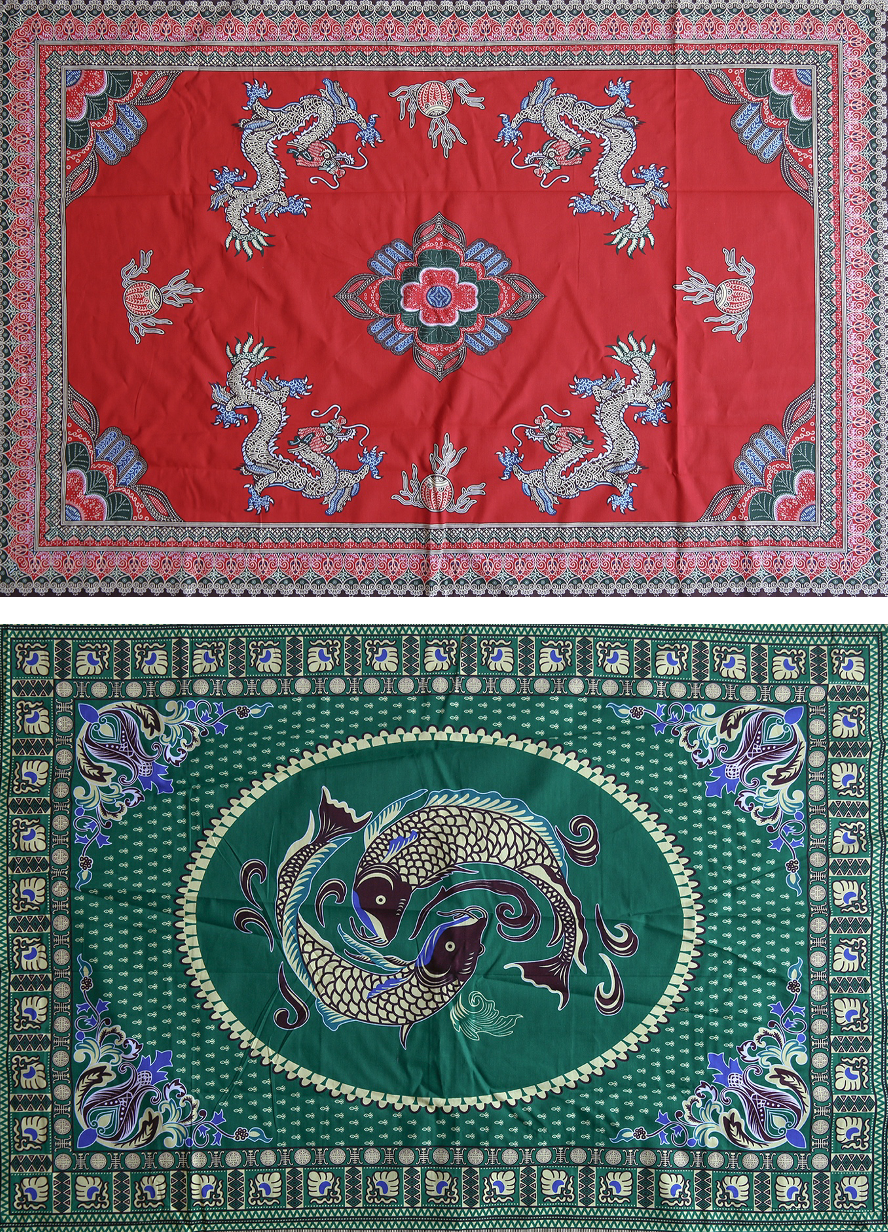
Two African Wax Print featuring Chinese motifs shown here was later found in Zhongda Fabric Market in Guangzhou. (photo by Hangfeng Chen)
This made me question what we really mean by concepts such as "original," "authentic," or "copy." Is the history of imitation really a contemporary Chinese phenomenon? Or has culture always been shaped through repetition, appropriation, translation, and reinvention? Perhaps originality itself has never been fixed, but continually produced through movement, misunderstanding, and exchange.
While researching African Wax Print, I also encountered another fascinating hypothesis: that Indonesian Batik itself may have originated from Chinese Indigo textiles. The historical evidence remains inconclusive. Some scholars trace the technique back to the Tang dynasty, while others argue that Indigo printing had already existed in China more than two thousand years ago. The technology may then have travelled through India before being introduced to Indonesia by Arab traders during the thirteenth century, where it evolved into an entirely different textile tradition. Then, only a few days ago, I came across a new archaeological discovery. Researchers identified evidence of Indigo techniques in Peru dating back approximately 6,000 years—significantly earlier than any comparable evidence currently known in Asia.
History seems constantly to rewrite itself. Every new discovery complicates the search for origins, making them increasingly elusive. If tracing origins is one way of questioning history, I find myself drawn to another question instead. Could the patterns now designed and manufactured in China, and increasingly embedded within African visual culture, eventually give rise to a new aesthetic phenomenon—much as Chinoiserie once did in Europe? Might they, in turn, reshape not only the future of African visual culture, but also the world's imagination of Africa itself?
About the Made in China exhibition
What does the label “Made in China” mean? In this exhibition, you will delve into China's rich and diverse manufacturing culture: from thousands of years of craftsmanship to contemporary art and design. Wereldmuseum presents an inspiring mix of objects, artworks, fashion, photography, videos, interviews with makers and interactive maps that together tell a multifaceted story about Chinese craftsmanship, then and now. The exhibition is on display until August 30, 2026. To learn more about Made in China, click here.